
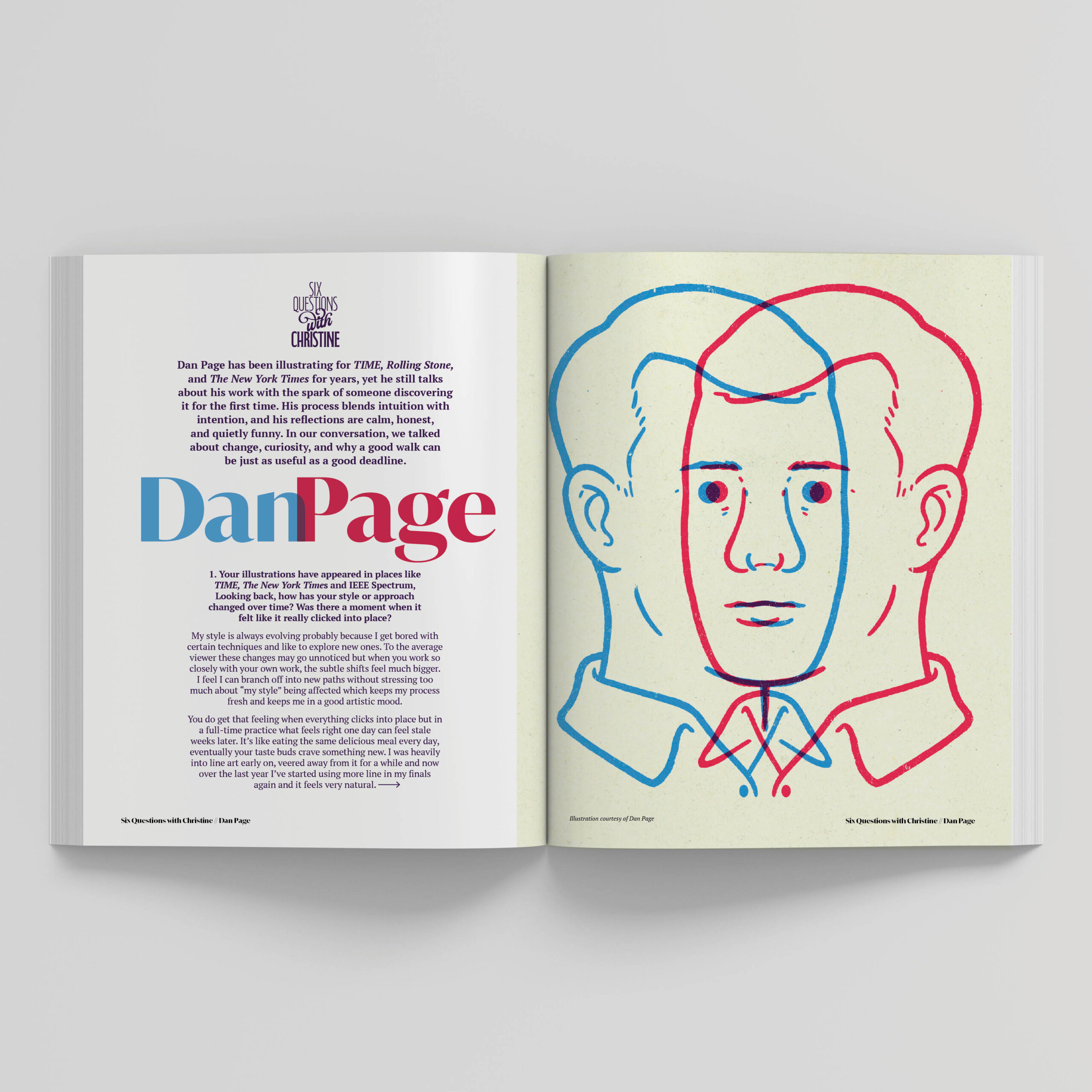
Illustrator Dan Page discussed stylistic evolution, creative flow, and trusting intuition in his recent interview for Six Questions with Christine, a blog series created by designer Christine Goucher.

1) Your illustrations have appeared in places like TIME, The New York Times and IEEE Spectrum. Looking back, how has your style or approach changed over time? Was there a moment when it felt like it really clicked into place?
My style is always evolving probably because I get bored with certain techniques and like to explore new ones. To the average viewer these changes may go unnoticed but when you work so closely with your own work, the subtle shifts feel much bigger. I feel I can branch off into new paths without stressing too much about “my style” being affected which keeps my process fresh and keeps me in a good artistic mood.
You do get that feeling when everything clicks into place but in a full-time practice what feels right one day can feel stale weeks later. It’s like eating the same delicious meal every day, eventually your taste buds crave something new. I was heavily into line art early on, veered away from it for a while and now over the last year I’ve started using more line in my finals again and it feels very natural.
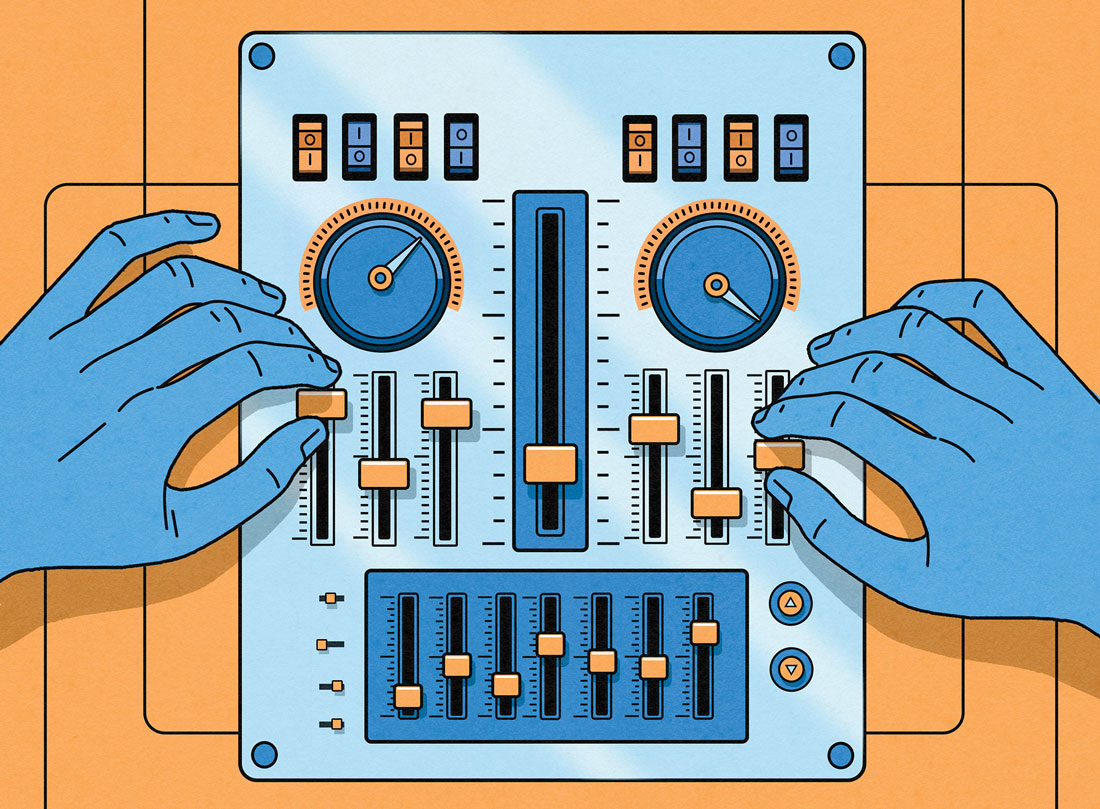
2) When you start a new piece, what does that first spark usually look like? Can you walk me through how an idea moves from early sketches to a finished illustration?
With each new assignment I get excited about the collaboration, possibilities and outcomes. As a conceptual illustrator the thinking and sketching stage is critical. I like to dive deep into the topic more so if it’s something I’ve never encountered before. Luckily, I’m naturally curious so I enjoy wrapping my head around the unknown. For me, the initial sparks usually come from reading the article and doing surrounding research, and credit goes to the amazing journalists and their writing skills.
Anxiety and high expectations (from myself) are constant throughout this process but they often push me toward directions I’m happy with. Once a sketch is approved the heavy lifting is done. Creating the final illustration is mostly technical, and depending on the subject I may need reference material to communicate clearly. Deadlines also play a role, and I find that limited time often fosters both inspiration and productivity.

3) Every creative career has its hurdles. What is one challenge that pushed you to grow as an illustrator, and what did you take away from it?
One challenge that really pushed me to grow as an illustrator has been managing work-life balance. It’s so easy in this career to become a workaholic, there’s always a commission or something to do to grow your business or just experimenting with new work. Early on I would work long hours without thinking about the impact on my health and I realized it actually affected the quality of my work. Over time I learned that taking care of myself, getting enough sleep, moving my body and even just setting boundaries around work helps me produce higher quality art. That lesson has stuck with me, how I live and how I create are really connected.
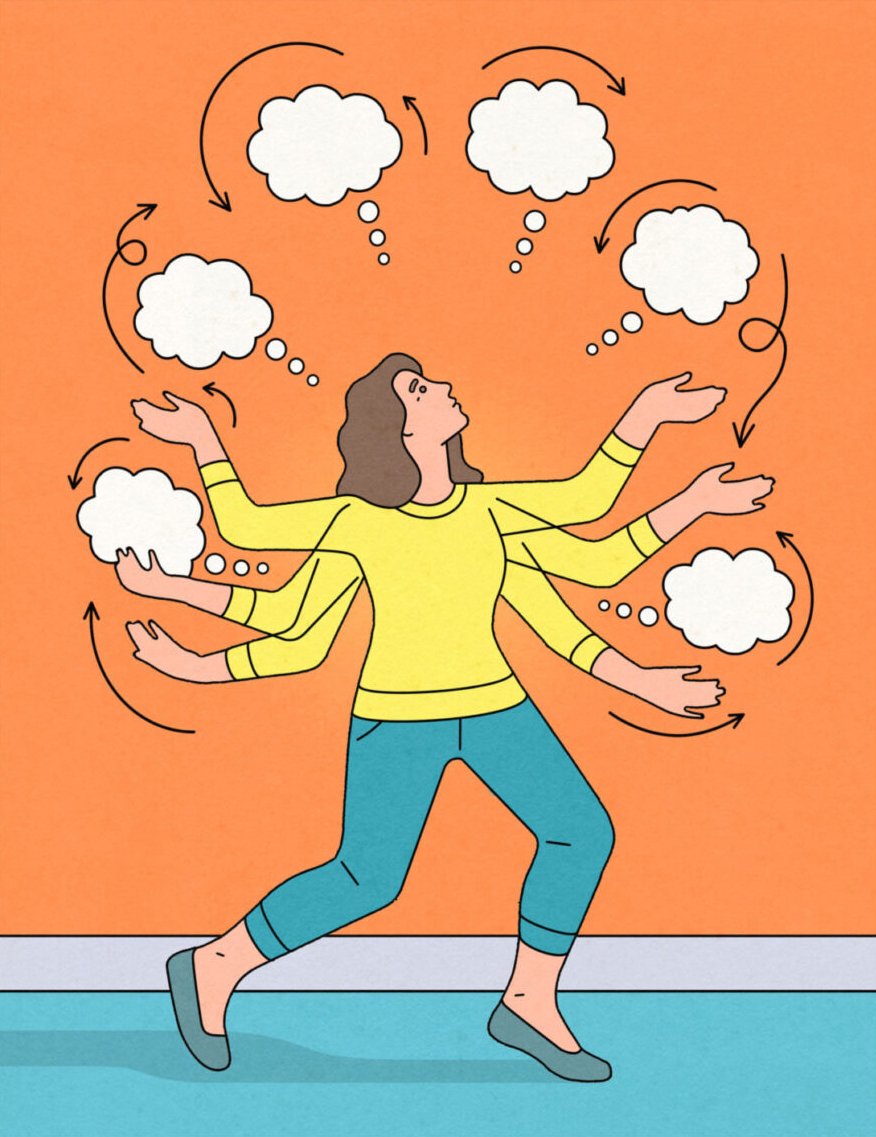
4) Across all the assignments, who or what has had the biggest influence on your voice as an illustrator? Has there been a collaboration that opened up a new way of seeing or working for you?
The biggest influence on my voice as an illustrator has been working with art directors who actively seek out my perspective. Their confidence in my ability to contribute meaningfully to the design and communication of a piece has encouraged me to trust my own creative instincts and shape my visual voice.
Since my work is mostly conceptual, I’ve been lucky to collaborate with art directors who’ve supported my shifts in style over the years. Those experiences taught me that the concept guides the visual direction. That realization really changed the way I approach each project.

5) After so many projects and high profile commissions, what is something unexpected you have discovered about illustration or about yourself as an artist that still stays with you?
Something unexpected I’ve discovered about illustration is how much of it relies on intuition. Early on, I thought every decision had to be carefully planned, but I’ve learned to trust those gut instincts, the quick visual choices or ideas that just feel right. Working constantly under deadlines tests your intuition and it has taught me to trust myself as an artist.

6) I know your daughter is also an illustrator, which is a wonderful continuation of the passion. When you need to reset or find fresh inspiration, what helps you spark new ideas, and has seeing her path brought anything new to your own?
I may have touched on this already with work-life balance, taking space from my work is a perfect way to recharge. Time away from my studio does amazing things for creativity. Even just moving your body can help ideas flow, I love walking my dogs, getting outdoors and exercising, all of which can break through creative blocks. I can remember so many times when an idea suddenly appeared while doing something active.
I work from home and live with my wife, we’ve raised three daughters and now have two dogs. One of my daughters is also an illustrator and I’m extremely proud that we share the same profession. Even though we’re in different places in our careers most of what we experience is the same. Working in isolation is one of the hurdles of being an illustrator but even though my daughter lives in another city it doesn’t feel so isolating anymore. We support each other, share the challenges and bounce ideas off each other, just a few of many ways her path has enriched my own.

Dan’s reflections remind us that creative growth doesn’t always come from chasing reinvention. It comes from staying curious, trusting your instincts, and letting space, not stress do its quiet work.